Scroll LinkedIn for a few minutes and you will find them. A recruiter claims to hire executives for Amazon, Microsoft and Google, and asks you to "send your CV to" a free email address. The account behind it was often silent for years, then suddenly posts the same text again and again.
These posts were especially visible during the layoff periods, when people understandably want a better job quickly. That is exactly why they work.
What a fake post looks like
Red flags
- A free-mail address for a "global recruiter"
- A long list of famous brands but no specific role
- A wall of hashtags
- A dormant account that suddenly posts, then reposts the same text a week later
- A poll at the end, always the same kind of poll
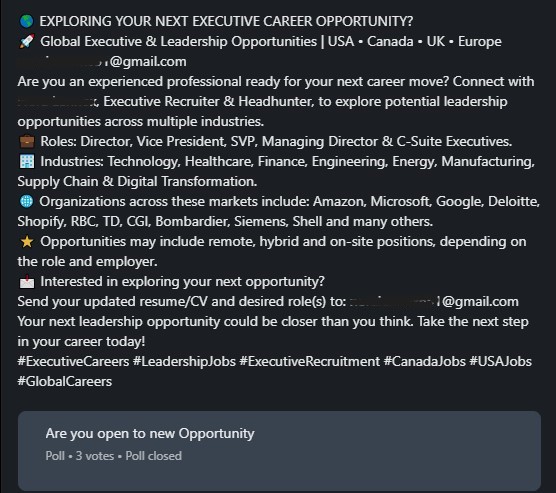
Look at the wording: opportunities "may include" remote or on-site positions, and the post only invites you to "explore". Nothing promises a real job. It ends with a poll that had 3 votes.
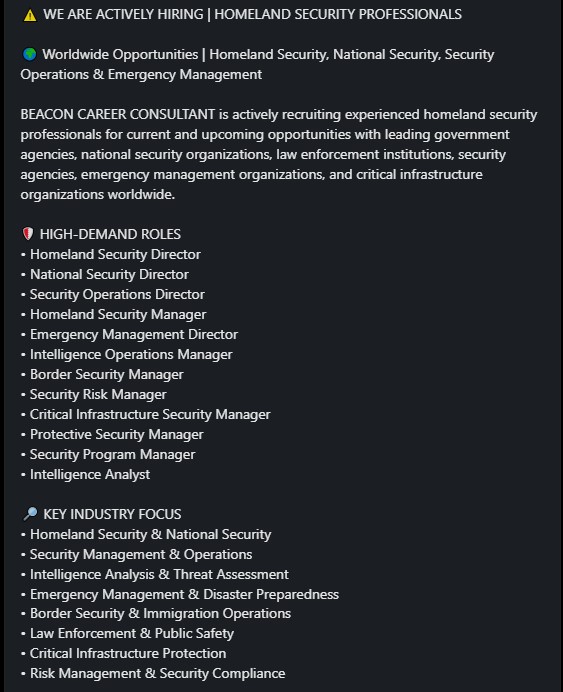
This one is aimed at a different audience: security professionals. Roles like these are typically filled through official agency channels, with citizenship checks, vetting and security clearances. A generic post collecting CVs for "government agencies worldwide" is not how that works. For anyone attacking people, a CV from someone in national security is worth far more than one from a random job seeker.
Checking the domains
The company name in that second screenshot matches a domain, so I looked up the public WHOIS records (accessed 2026.11.05):
beaconcareersconsulting[.]com: registered 2026.08.18, expires 2027.08.18beaconcareerconsultant[.]com: registered 2026.09.16, expires 2027.09.16
Both use the same name servers and hide the owner behind a privacy service, so the registrant is not public. That is consistent with a single operator, but shared registrar defaults are not proof of it. What the records do show is an "established recruiting agency" whose domains were registered a month apart and are both less than three months old.
Several legitimate staffing firms also have "Beacon" in their names, so a similar name proves nothing on its own. The registration dates, the hidden owner and the behavior of the posts are what stand out.
People are reporting
In a LinkedIn post (may require sign-in; accessed 2026.11.05), its author, who regularly exposes recruitment scams, describes the same pattern: an account created years ago whose history was cleared out and replaced with fresh fraudulent posts, a bogus email address, a recurring poll, and a spoof "consultant" domain registered on 16 September 2026. That date matches the WHOIS record above. Their advice is not to engage, and to report the profile.
If you want to help, there is a LinkedIn group for reporting job scams: the job-scam reporting group (may require sign-in).
What a CV gives away
Think about what a CV contains: your university, your birthplace, your past employers and your phone number. Those are the answers to common security questions. And a "cover letter" explaining why you want this job is useful leverage against you.
Not just petty scams
Fake recruitment is also a professional tactic. Researchers describe it as a known method of TraderTraitor, the North Korean group blamed by the FBI for the US$6.3 billion Binance theft. In the DMM Bitcoin theft, an employee ran a Python script from a fake LinkedIn recruiter as a pre-employment test.
What to do
- Check the company's own careers page and the recruiter's real domain.
- Be suspicious of free-mail addresses and posts that promise nothing specific.
- Never open a recruiter's test or coding assignment on a work computer.
- Share only what the application needs.
- Report the profile on LinkedIn, and do not engage with it.
Binance has not said how its engineer's laptop was compromised. DMM Bitcoin did: a fake LinkedIn recruiter and a "pre-employment test". This is how companies get hacked into, and your workplace could be next.
Sources
- FBI links $6.3 billion Binance crypto heist to North Korean hackers (BleepingComputer)
- Binance links $6.3 billion theft to a compromised DevOps laptop (BleepingComputer)
- Binance attack: how DPRK targets developer laptops (Jamf)
- FBI confirms North Korea was behind the hack (LBC)
Related: Patch the wound before it festers: CVE-2026-111560 and "hack-a-ware".
Last updated: 2026.11.06 18:12 CET.